
In an effort to tackle the pressing issue of educational disengagement and youth homelessness, Upstream Canada is making significant strides through its school- and community-anchored early intervention model.
Upstream Canada emphasizes cross-sector collaboration and is centred on youth and family supports. By prioritizing early identification through universal screening, reducing stigma, removing barriers, and connecting youth to community-based supports.
The goal? Keep youth in school, support their well-being, and prevent homelessness before it happens.
Spotting the Early Warning Signs
Since its implementation in 2021, 3,136 students in Grades 7-8 from two community demonstration sites, Kelowna, B.C. and Newfoundland and Labrador (St. John’s and Marystown), have completed the Student Needs Assessment (SNA), a validated universal screening tool. This assessment evaluates key indicators across mental health, peer and family relationships, housing stability, and school connection.
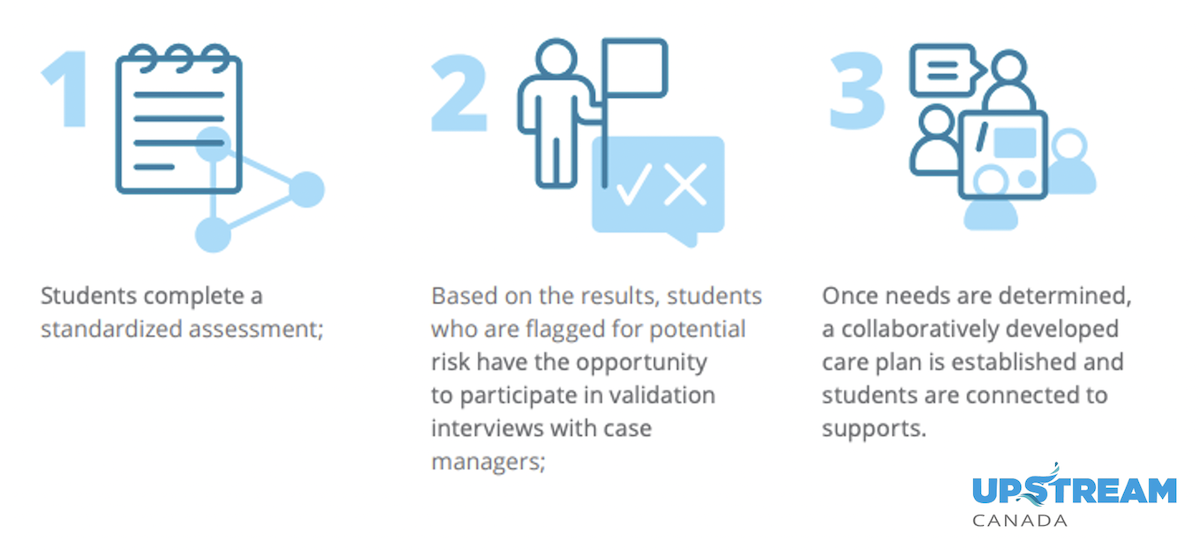
How Upstream Canada Works
By July 2025, 1,076 (34.3%) were identified as at elevated risk:
- Low Risk: 792 students
- Moderate Risk: 202 students
- High Risk: 82 students
This multi-tiered approach helps schools identify not only students in urgent need of supports but also those showing early warning signs of trouble—students who might otherwise slip through the cracks of traditional referral systems.
Reaching Youth Who Need Support Most
As of July 2025, 561 students have received direct supports through Upstream Canada:
- Kelowna: 346 engaged (258 discharged)
- Newfoundland and Labrador: 215 engaged (146 discharged)
These supports range from building coping skills and improving family relationships to helping youth feel more connected at school.
Addressing Disproportionate Risk
The SNA data also highlighted who is at greater risk:
- Indigenous students: 51.8% were flagged as at risk, vs. 33.6% of non-Indigenous students. Additionally, Indigenous students were nearly twice as likely to be at high risk of homelessness (6.5%) as their non-Indigenous peers (3.2%).
- 2SLGBTQIA+ students: 58.1% were flagged at risk, vs. 33.9% of students who did not identify as 2SLGBTQIA+. This group was three times more likely to fall within the moderate risk category (21% vs. 7.3%) and significantly more likely to fall into the mild risk category (35.5% vs. 22.8%). These trends indicate significant challenges 2SLGBTQIA+ youth face in achieving housing stability, social inclusion, and mental health, which often go unnoticed by traditional systems.
This shows the importance of Upstream Canada’s universal screening approach, which identifies vulnerabilities that might otherwise remain hidden.
Signs of Positive Change
A developmental evaluation led by Dr. Steve Patty from the Okanagan Boys and Girls Club in Kelowna assessed short-term outcomes related to youth well-being, school engagement, and systemic responsiveness. Youth participants reported:
- 72%: “I feel safer than I used to feel”
- 72%: “I am more aware of resources available to me”
- 66%: “I have more positive role models”
- 66%: “I am better able to tell people what I need”
- 63%: “I am more comfortable at school”
- 60%: “I am doing better in school”
In their own words, youth and caregivers described:
- Improved intrafamilial communication, bridging generational and relational divides
- Enhanced emotional regulation and self-awareness
- Strengthened confidence and identity development
- Improved school attendance, engagement, and goal-directed behaviour
- Development of supportive peer networks and clearer boundary-setting
- Expanded capacity for self-care, planning, and future orientation
These outcomes emphasize the importance of supportive, judgment-free relationships with caring adults as the foundation for positive change.
What Educators are Saying about Upstream Canada
Teachers and school staff see Upstream Canada as filling gaps that traditional systems can’t always cover:
- Rapid response capacity for student crises beyond school infrastructure
- Reduced pressure on educators through shared responsibility for student well-being
- Access to supports outside of school hours (evenings, weekends)
- Increased school attendance and emotional readiness to learn
- Embedded delivery reducing access barriers and stigma
- More effective navigation of complex service systems
- Strengthening of cross-sector collaboration, enhancing systemic coherence
These findings suggest that Upstream Canada not only fosters individual resilience but also strengthens institutional and interagency capacities, creating a more supportive and responsive environment for all students.
The bottom line: Upstream Canada is paving the way for a proactive approach to youth support, ensuring that no student falls through the cracks. By focusing on early intervention and community collaboration, we can work towards reducing long-term disparities and promoting equitable outcomes for all youth in Canada.