
What might the creation of a statutory obligation for the provincial government to have a ‘duty to assist’ those at risk of, or actively experiencing homelessness, mean to our community? According to participants at our Winnipeg-based event in October 2024, it would mean a commitment to Reconciliation.
If there were adequate financial support provided to each system (i.e., Education, Health, Child and Family Services, Justice, and Children’s Disability), geared towards prevention efforts that incorporate cultural and traditional understandings of holistic well-being, it is argued that youth homelessness could be eradicated. Eradication of youth homelessness would have a profound impact on individual youth and their families, service providers and the community as well as our society as a whole. Looking through a lens of Seven Generations, we would also have a chance of eradicating all forms of homelessness for future generations by taking away a major entry point.
If we can prevent people from ever falling into homelessness at a young age and provide them with stability, security and safety, we are most likely preventing them from ever experiencing houselessness during their life course therefore eliminating intergenerational poverty and houselessness.
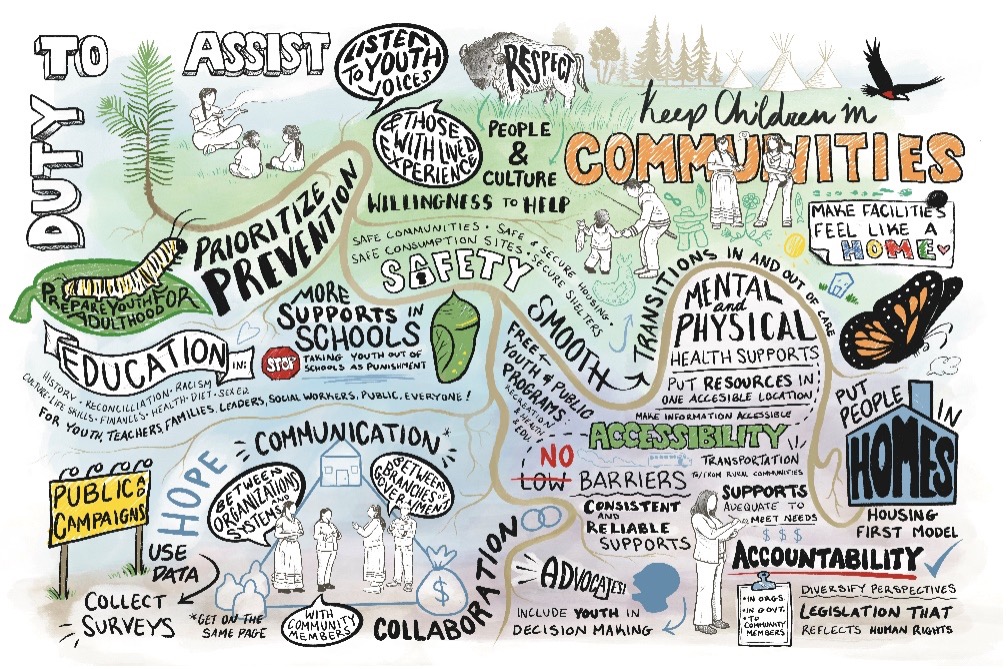
Illustration of the Duty to Assist, based on discussions at the Winnipeg event in October 2024.
This third blog post in the series explores the overarching themes that legislative reform should consider to move towards equity and away from retribution.
What should statutory reform look like if we are to tackle youth homelessness and prevent intergenerational experiences of trauma?
What would legislative reform need to look like? Statutory reform must move towards restoration of equity and away from, retribution.
What does this mean? That people don’t have to go through repetitive experiences of trauma before receiving services. This means an upstream approach to prevent people from ever experiencing homelessness, and equity-based processes across all systems.
Participants identified that restorative action needs to be grounded in:
- Streamlined access to supports
- Consistency and reliability of supports
- Restorative justice and equitable practices
- Housing and employment support
- Education and youth support
1. Streamlined Access
- Unified Database/System: One shared system with all relevant information.
- Avoid Re-traumatization: No repeated or intrusive forms or intake processes.
- Centralized Access: One-stop access for services/resources (phone app, emergency support). As one table wrote, “An app that can be used as a resource that will help map out service supports they need. May include mental health, housing, community cultural events”. Further, there should be infrastructure in place to support the transitions ‘out of’ and ‘between’ interacting systems.
2. Consistency and Reliability
One of the hardest things to do is take the first step and reach out to ask for support, especially as a vulnerable youth. Far too often this important first difficult step is met with an incredibly long wait time for urgent situations, a ‘wild goose chase’ in providing necessary forms, signatures, etc., that the youth may not have access to or need transportation to, as well, sometimes the youth is even met with apathy, or negative reactions to their brave step of reaching out for help.
Participants want to see a:
- Team Approach: Promoting a collaborative team model, rather than having individual caseworkers is important. Participants posited that this would alleviate the burden of large caseloads on workers, and allow for shared knowledge, person-centered support and a combined effort.
- Reliable Support: Consistent and immediate resources available for those reaching out, not denying or turning away youth at service points for any reason is needed; “No barriers rather than ‘low’ barrier”.
- Training was also described not only as being critical to consistency and reliability of service provision, but also the need to “intentionally teach and train people to see how unwell the system is, and to critically examine possible solutions” was emphasized.
Further, training for existing employees is critical, to keep staff updated with changing systems, trauma-informed practices, and person-centred support approaches. For instance, service providers and other professionals who work with youth, should be required to have updated training on a regular basis (such as 2 years), so they can stay actively informed on the rapidly changing world of mental health, trauma-informed care, harm reduction, and anti-oppressive practice.
Restorative Justice and Equitable Practices
- Restorative, Not Retributive Justice: Shifting from punishment to restoration and rehabilitation models is critical. Youth should not be punished for being poor or in the systems they are born into over which they have no control.A consistent theme reflected by participants and lived experts, is that they were discriminated against, disciplined or mistreated because they were experiencing poverty, homelessness, mental health issues, instead of being supported or treated with kindness and empathy. The very systems that are there to offer supports can often be another area of traumatization for young people and can often leave them feeling hopeless. Youth who bravely reach out for help when they are struggling or are on the verge of homelessness or suffering severe mental health issues have sometimes been turned away and told to ‘try harder’ without any support to do so being provided.
Further, often when these youths move farther down the systems pipeline, they are then reprimanded for not seeking help earlier. As one table states, “help (should) not be unavailable because people are not homeless or struggling ‘enough’”.
- EIA System Overhaul: Including, streamlined application process, ability to work and receive support, no longer “clawing back earnings”, and re-consideration of the EIA rates. The current rates, “promote poverty with below poverty line income support” and don’t allow for applicants to improve their financial futures.
- Universal Basic Income: At almost every table, “support Universal Basic Income” as well as a “living wage/ living basic income” was mentioned, highlighting its importance. This is a foundational economic support model that in many different practical trials has shown extremely positive results and life-changing stability for participants.
Housing and Employment
- Landlord Engagement: Fostering relationships with landlords, accept rent subsidies, holding landlords to higher and more enforceable standards and regulations that protect tenants’ rights is an important element.
- Eviction Prevention: Including rent top-ups and tenant insurance for youth, mentorship or case workers who can help advocate on behalf of, or alongside youth are also needed.
- Employment Pathways: Providing programs that lead directly to employment is another important factor.
- Understanding supports required for stable housing: Focusing on reunification and youth stability, as well as community building, alongside housing needs of the individual is required. There also needs to be better understandings of what housing instability is, and recognition that as one table described this way, “shelters shouldn’t be considered hous[ing]”. Participants also identified that there should be appropriate access to housing and education in First Nations communities, so that people don’t have to migrate to urban locations due to limited opportunities in community. Finally, participants call on Housing First programs, specific for youth aging out of the child welfare system.
Education and Positive Outcomes for Youth
- Policy Reform and Promoting ‘Schools as Hubs’ for Support: Changing suspension and absenteeism policies, to ensure that children, youth and families are not being ‘punished’ for factors that are outside of their control is needed. Participants identified that schools could act as ‘hubs’ to support children, youth and families, in the community and that onsite mentors, peer-to-peer supports, and outreach involvement should be promoted within the schools. Ideas such as extended after-school and evening activity programs and parent/family rooms, as well as a rotating support worker/counsellor that has days where they are present at several schools within a division was also proposed by participants.
- Alternative High School Models: Youth-centered alternative education can make the difference between students dropping out or eventually being able to graduate. Participants also suggested that the education system needs to “re-define winning”, suggesting that successes (even the ‘smaller’ successes) of individuals should be celebrated, such as “attend(ing) their events with them to cheer them on”, rather than punitive approaches taken to ‘compel’ students to attend school.
Participants consistently called for a person–centered approach to legislation creation that prioritizes the needs and voices of the youth. In their own words: “Nothing for me without me.”
Looking Ahead
Lived-expert, youth-driven expertise is vital to the creation of impactful policy reform. Important to the development of the summary report and the series of blog posts is the intricate involvement of the Youth Advisory Council at End Homelessness Winnipeg. The next two posts will be developed primarily from a youth-lens, and reflect their priorities in understanding what is required for the next steps in moving Duty to Assist.